How a proposal for peer-to-peer cash became a network, a market, a governance problem and an object of state policy.
Twenty-six events are reconstructed from software, blocks, mailing-list posts, court records, laws and official announcements—with decoded transactions, protocol code and measured data placed beside the history they explain.
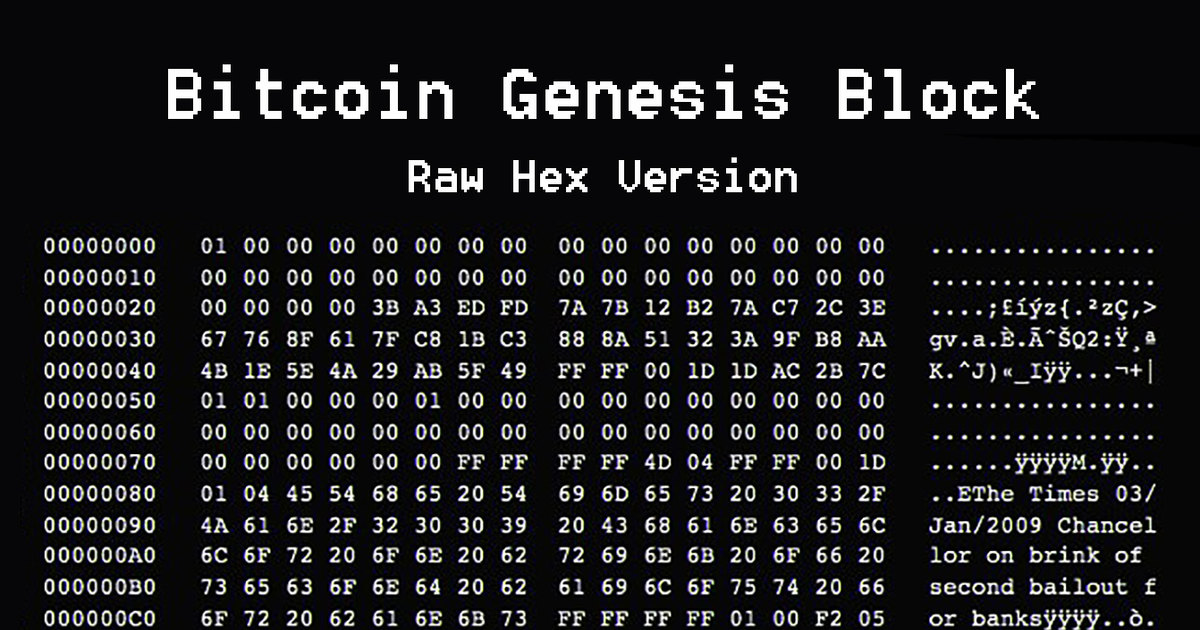
Block 0, rendered as raw data. The newspaper headline embedded in Bitcoin’s first block is legible at right.
Bitcoin software / MikeG001 · public-domain and MIT-licensed material · Wikimedia Commons
Reference coordinates
Six dates that orient Bitcoin history.
A fast, source-linked route from the white paper to the fourth halving. Each coordinate opens the dated record, its technical locator and the evidence used to verify it.
Read the history in sequence, investigate one contested subject, or take the underlying source catalog into your own work. Every path returns to the same dated record.
01°
Historical phase 01
Reference pointPRE-CHAIN FOUNDATIONSRecords 01—02
1976—2008
Ideas before the network
Bitcoin did not invent cryptography, digital signatures or proof-of-work. Its breakthrough was arranging known
components so that strangers could agree on one payment history without appointing a central ledger keeper.
Digital information is easy to copy. That is useful for communication and disastrous for money: if the same unit can
be spent twice, somebody must decide which payment came first. Early electronic-cash systems usually solved this with
a bank, issuer or registrar that maintained the authoritative record.
Several ideas weakened that dependence. Public-key cryptography made it possible to prove authority with a digital
signature. Haber and Stornetta described linked timestamps that made later alteration evident. Adam Back’s Hashcash
attached computational cost to messages. Wei Dai’s b-money proposed a network in which participants collectively kept
accounts. These were antecedents, not earlier versions of Bitcoin; none combined open participation, a single ordered
ledger and an incentive system in the same way.
REC 02ProtocolMailing list / white paper
The proposal
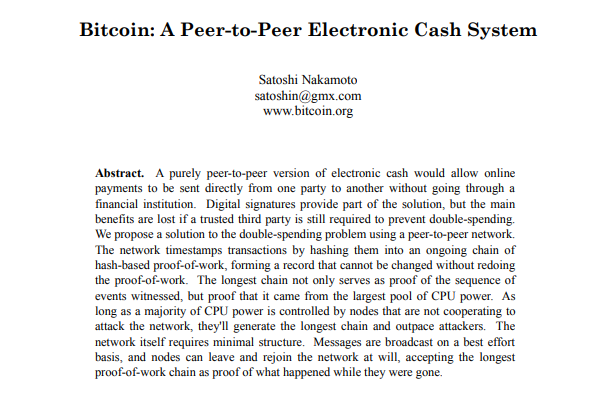
A nine-page paper proposes electronic cash without a trusted third party.
A message signed “Satoshi Nakamoto” arrived on the Cryptography Mailing List with a link to Bitcoin: A
Peer-to-Peer Electronic Cash System. Its central proposal was a public timestamp chain secured by proof-of-work.
Transactions would be broadcast to peers; miners would order them into blocks; nodes would accept the valid history
backed by the greatest cumulative work.
The design joined security to economics. The winning miner could claim newly issued bitcoin and transaction fees, giving
participants a reason to spend real resources securing the history. A difficulty adjustment aimed to keep block
production near a ten-minute average as computing power changed. A fixed issuance schedule made the monetary rule
knowable in advance rather than subject to a central operator.
The paper appeared during the global financial crisis, but the document itself is technical rather than a complete
political manifesto. Later events—and the message embedded in block 0—would make that setting impossible to ignore.
White paper / 2008. The title and abstract distributed to the Cryptography Mailing List.
Satoshi Nakamoto · facsimile via Wikimedia Commons
What changed
A problem previously handled by an institution had been reframed as a public competition governed by verifiable rules.
02°
Historical phase 02
Protocol anchorGENESIS HEIGHT 0Records 03—07
2009—2011
A network learns to become money
A specification is not a network, and a token is not automatically money. The first years were a sequence of social and
technical bootstrapping events: peers joined, value was tested, a critical bug was repaired and the creator disappeared.
version / prev_block / merkle_root / time / nBits / nonce
REC 03On-chainHEIGHT 0 / GENESIS BLOCK
The ledger begins
The genesis block fixes a starting point.
Bitcoin’s first block established the reference point from which every later block descends. Its header records a UTC
timestamp of 18:15:05. Inside the coinbase data, Satoshi placed a headline from that day’s Times:
“Chancellor on brink of second bailout for banks.” The headline proves the block could not have been created before the
newspaper appeared; it also tied Bitcoin’s beginning to the banking-crisis era without conclusively explaining every
motive behind the project.
The block specifies a 50 BTC subsidy, although its output cannot be spent because of how the genesis block is hard-coded.
More important than the nominal reward was the chain it began: each accepted block would reference its predecessor,
turning any attempted historical rewrite into a growing proof-of-work problem.
REC 04Network launchHEIGHT 170 / TX f4184f…9e16
Release 0.1
Independent peers turn code into a network.
Satoshi announced the first public software release on 8 January. Early users ran both wallet and node functions on
ordinary computers, relaying transactions, checking signatures and competing to mine blocks with CPUs. Four days later,
block 170 recorded a 10 BTC transfer from Satoshi to cryptographer Hal Finney.
The transfer mattered because a second participant had independently received and validated state from the network.
Bitcoin was no longer only a paper or a database maintained by its author. It had begun the difficult process of
bootstrapping shared rules among machines controlled by different people.
Data 01Transaction f4184f…9e16
Bitcoin spends outputs; it does not edit an account balance.
Spent in full50 BTCblock 9 coinbase output
→
Recipient10 BTCHal Finney
Change40 BTCnew output to sender
Fee
0 sat
Serialized size
275 bytes
Weight today
1,100 WU
Confirmed
block 170
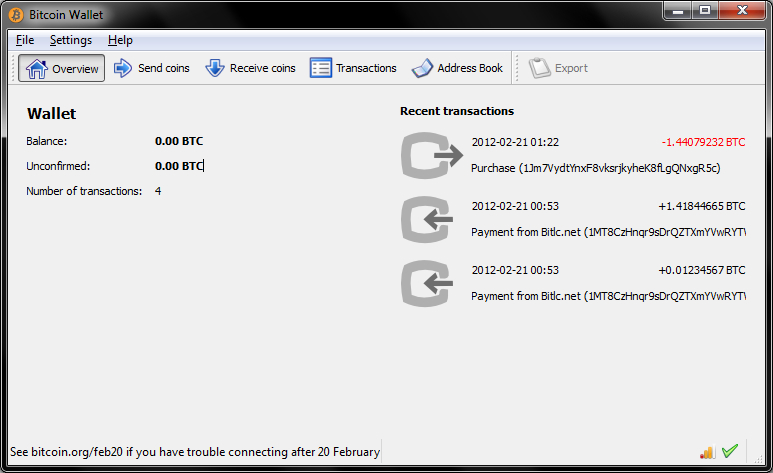
Confirmed 12 January 2009 at 03:30:25 UTC. The 50 BTC input disappears from the unspent-output set and is replaced by two new outputs. Inspect the transactionRetrospective software view / 2012. Wallet, node and network status in one desktop application.
Bitcoin developers · MIT licence · Wikimedia Commons
REC 05Market10,000 BTC / forum agreement
Price discovery
Two pizzas make exchange value visible.
Programmer Laszlo Hanyecz offered 10,000 BTC to anyone who would arrange the delivery of two pizzas. Another forum user
accepted. It was not necessarily the first exchange involving bitcoin, but it became the first widely documented purchase
of physical goods with it.
The important development was social: two people had negotiated a rate between a scarce digital asset and ordinary goods.
That did not create a universal market price, but it demonstrated that bitcoin could move beyond tests among developers
and serve as consideration in a real transaction.
REC 06ConsensusINCIDENT AT HEIGHT 74,638 / PATCH 76793dc
Value overflow
A critical bug reveals that consensus is still software.
A malformed transaction exploited an arithmetic overflow and created outputs totaling more than 184 billion BTC—far
beyond the intended supply. Developers released a fix within hours. As upgraded participants accumulated more work on the
corrected history, nodes abandoned the chain containing the invalid creation.
The incident is essential to understanding early Bitcoin. The monetary limit was an intended rule, but the code enforcing
it contained a defect. Recovery required people to diagnose the problem, publish software and coordinate adoption. The
episode showed both fallibility and a capacity for rapid repair while the network was still small.
REC 07GovernanceEmail archive / BIP 1
The creator withdraws
Bitcoin continues without Satoshi’s public direction.
In one of the final known messages, Satoshi told developer Mike Hearn that the project was “in good hands with Gavin and
everyone.” Responsibility for maintenance and discussion had already begun to spread among contributors. Satoshi’s exit
removed a uniquely authoritative voice but did not remove the need for coordination.
Bitcoin Improvement Proposals, or BIPs, became the durable format for documenting substantial ideas. A BIP can specify a
change and explain its rationale; it is not legislation. Authors still need to persuade developers, businesses, miners and
users, and consensus changes only become effective when software enforcing them is actually adopted.
What changed
Bitcoin had acquired peers, exchange value, a repair history and a development process that no longer depended on its pseudonymous author.
03°
Historical phase 03
Protocol anchorHALVING I HEIGHT 210,000Records 08—13
2012—2016
Markets, mining and custody
Exchanges, hosted wallets, mining pools and specialized hardware made Bitcoin more usable and more secure. They also
reintroduced intermediaries whose failure could harm users even when the ledger continued to operate exactly as designed.
version / prev_block / merkle_root / time / nBits / nonce
REC 08IssuanceHEIGHT 210,000 / MAX SUBSIDY 50 → 25 BTC
First halving
The subsidy falls from 50 BTC to 25 BTC.
After 210,000 blocks, the issuance rule reduced the maximum subsidy available to a miner by half. No committee announced
a new rate. Nodes running compatible rules simply rejected any block that claimed more than 25 new BTC after the boundary.
A halving does not mechanically set bitcoin’s market price, nor does it guarantee a specific number of blocks each day.
It lowers subsidy revenue per valid block and increases the long-run importance of transaction fees to the security
budget. The calendar date is an outcome of irregular block times; the height is the consensus trigger.
REC 09ConsensusBIP 50 / BITCOIN 0.7–0.8
Accidental chain split
Two software generations temporarily disagree.
A block accepted by Bitcoin 0.8 nodes exceeded an undocumented database constraint in older 0.7 software. For several
hours, the network built two incompatible histories. Developers and mining-pool operators coordinated a temporary return
to the older branch, allowing the network to converge while a safer upgrade path was prepared.
The post-mortem became a landmark governance document. It showed that compatibility assumptions can become consensus
rules in practice, even when nobody intended them to be. It also showed the role of social communication during an
emergency: proof-of-work selects among histories that nodes consider valid, but software determines validity.
REC 10Law & policyFIN-2013-G001
United States guidance
Regulators distinguish users from money transmitters.
The U.S. Financial Crimes Enforcement Network issued guidance for “decentralized virtual currencies.” A person using
virtual currency to buy goods or services was not treated as a money-services business merely for that use. Administrators
or exchangers accepting and transmitting value could, depending on their activity, be money transmitters subject to
registration and anti-money-laundering obligations.
The distinction helped define the legal perimeter around exchanges and payment businesses. Regulation did not attach to
the open-source protocol in the same way it attached to companies exchanging bitcoin for sovereign currency or holding it
for customers.
REC 11Law & policyDOJ PRESS RELEASE
Silk Road
A seizure places Bitcoin inside a major criminal case.
U.S. authorities arrested Silk Road operator Ross Ulbricht and seized infrastructure associated with the online market.
Later that month, prosecutors announced the seizure of additional bitcoin controlled through keys obtained in the case.
The event brought intense attention to bitcoin’s use in illicit commerce.
Bitcoin addresses are pseudonyms, not names, but the ledger is public. Transactions can be followed while investigative
records, exchange accounts, operational mistakes or seized devices connect some addresses to real people. The case did not
show that every user is identifiable from the blockchain alone; it showed how a permanent public record can become one
source of evidence among many.
REC 12CustodyCivil rehabilitation / Japan
Mt. Gox
The dominant exchange collapses; the distinction between bitcoin and an IOU becomes unavoidable.
Mt. Gox had grown from a trading-card exchange into the most important venue for bitcoin trading. After suspending
withdrawals and taking its website offline, the company applied for Japanese civil rehabilitation, reporting enormous
bitcoin and cash shortfalls. Its initial figures changed as assets were later located and investigations continued, but
the customer damage was profound.
The protocol did not fail, yet that fact offered little comfort to people who had lost access to funds. Bitcoin held in a
self-controlled address is spendable with the corresponding private key. A balance shown by a custodial exchange is a
contractual claim: the exchange controls the on-chain coins and owes the customer. Mt. Gox made the difference between
those two forms of exposure legible to an entire market.
Data 02Company-reported holdings · March 2014
From 850,000 BTC reported lost to 650,000 BTC still estimated missing.
≈850,000 BTCinitially reported lost
Estimated missing≈650,000 BTCLocated≈200,000 BTC
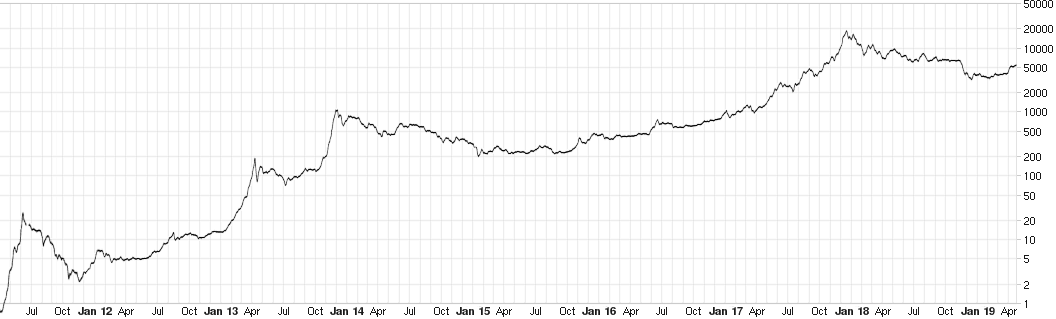
These were Mt. Gox’s own provisional figures, not a final forensic accounting. Locating an old wallet changed the estimate; it did not restore customers’ control. 20 March announcementRetrospective market series / 2011—2019. A log-scale record of dollar exchange rates. Mt. Gox supplies the early series; Bitstamp continues it after the exchange failed.
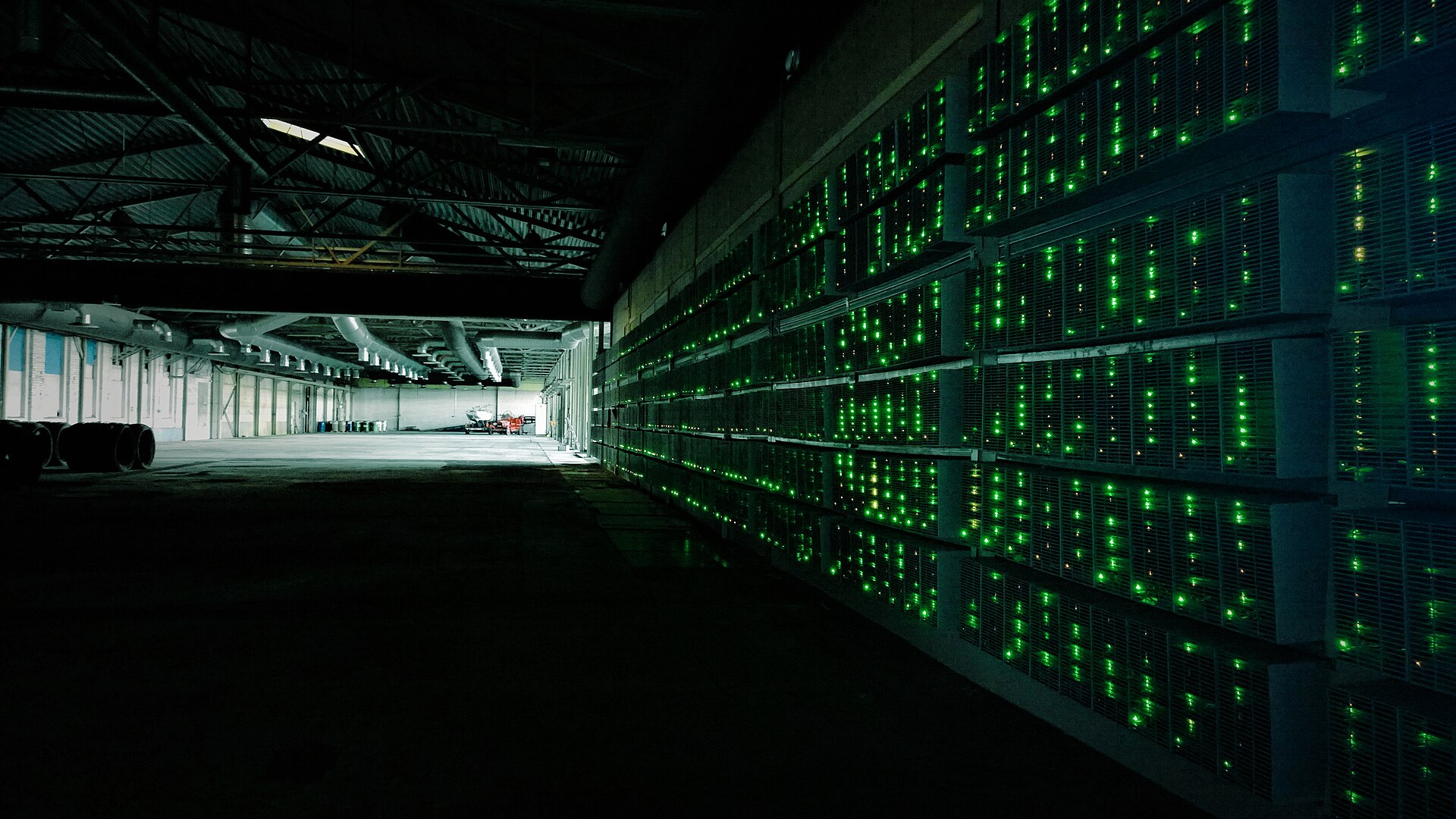
Public exchange data · public domain · Wikimedia CommonsMining infrastructure / 2014. Mining moved from home CPUs to GPUs, pools and specialized hardware. Industrial scale raised the cost of attacking the chain while concentrating access to efficient machines and energy.
Photograph: Marko Ahtisaari · CC BY 2.0 · Wikimedia Commons
REC 13IssuanceHEIGHT 420,000 / MAX SUBSIDY 25 → 12.5 BTC
Second halving
The subsidy falls again, to 12.5 BTC.
Another 210,000-block interval completed and nodes began enforcing the next reward limit. By this point, mining was an
industrial business and exchanges served a global market. The same issuance rule that had operated among hobbyists now
constrained a much larger economy.
The halving also sharpened the economic question that recurs in every era: as subsidy revenue declines, can fees provide
enough incentive to secure the network? Bitcoin’s design answers the supply question deterministically; the future market
for block space remains an economic outcome.
What changed
Bitcoin was no longer only peer-to-peer software. It had an industrial supply chain, regulated gateways and custodians whose incentives and failures shaped the experience of using it.
Demand for limited block space turned a capacity question into a governance crisis. The disagreement exposed competing
priorities: cheap on-chain transactions, inexpensive independent verification, backward compatibility and authority over
the rules themselves.
version / prev_block / merkle_root / time / nBits / nonce
REC 14ConsensusBIP 141 / HEIGHT 481,824
The scaling conflict
One dispute produces a protocol upgrade, a new chain and a lasting argument.
Bitcoin’s original one-megabyte block limit constrained how much transaction data could be confirmed at once. Advocates
of larger blocks emphasized throughput and lower on-chain fees. Opponents argued that continually increasing bandwidth,
storage and validation requirements would make it harder for ordinary users to run independent nodes, weakening the
system’s ability to resist invalid rule changes.
Segregated Witness proposed a backward-compatible restructuring: signature data was committed separately and block weight
replaced the old byte-only limit. The change increased effective capacity and fixed involuntary transaction malleability,
an obstacle to reliable payment channels. Activation stalled amid disagreement about signalling and authority. Pressure
from a proposed user-activated soft fork and miner coordination through BIP91 helped bring SegWit to activation at block
481,824 on 24 August.
The dispute did not end in consensus. On 1 August, Bitcoin Cash split into an incompatible chain with larger blocks.
A separate SegWit2x plan was later cancelled. The result was both technical and constitutional: competing communities
could preserve different rules, but neither miners, developers nor businesses alone could make every user follow them.
Payment channels move repeated activity away from the base layer.
Lightning participants lock bitcoin into an on-chain channel, exchange updated balances off-chain and retain the ability
to enforce the latest valid state on-chain. A network of channels can route payments between people who do not share a
direct channel, enabling fast, small transfers without recording every balance update in a block.
This is layered scaling rather than infinite capacity. Channels require liquidity and monitoring; routing can fail; users
may choose custodial services that reintroduce trust. SegWit’s malleability fix made dependable unconfirmed transaction
chains practical, helping Lightning implementations move from proposal toward production use.
REC 16MarketCME / 18 DEC 2017
Regulated derivatives
Bitcoin price risk enters a major futures venue.
CME launched cash-settled bitcoin futures for the 18 December trade date, shortly after Cboe introduced its own contract.
The products allowed professional participants to hedge or take a view on bitcoin’s dollar price within regulated
derivatives markets.
Cash settlement is the key distinction: no bitcoin needs to move on-chain when the contract settles. The milestone
expanded financial exposure to bitcoin without expanding direct ownership of private keys, a pattern that would become
even more important with later exchange-traded products.
REC 17IssuanceHEIGHT 630,000 / MAX SUBSIDY 12.5 → 6.25 BTC
Third halving
The subsidy falls to 6.25 BTC.
Bitcoin entered its fourth issuance era. At the protocol’s target pace of 144 blocks per day, expected new issuance fell
from roughly 1,800 to 900 BTC per day. Actual daily issuance varies because actual block production varies.
By then, a halving was simultaneously a consensus boundary, a stress test for mining economics and a recurring cultural
event. The rule itself remained simple; the effects on hash rate, fees and markets depended on participants’ costs and
expectations.
REC 18Corporate treasurySEC 8-K / 21,454 BTC
Corporate treasury
A public company makes bitcoin a primary reserve asset.
MicroStrategy disclosed that it had purchased 21,454 BTC for $250 million and adopted bitcoin as a primary treasury
reserve asset. The company framed the decision as a response to its view of long-term risks to cash; that rationale was a
corporate judgment, not a property guaranteed by the protocol.
Public companies had held or accepted bitcoin before, but the scale and explicit treasury policy made this a bridge to a
new institutional narrative: bitcoin as a balance-sheet asset rather than only a payment network or speculative holding.
What changed
Scaling moved upward into layers and outward into competing chains, while financial markets created new ways to gain exposure without participating directly in the network.
The monetary schedule
Scarcity is measured in block height, not calendar years.
Bitcoin Core right-shifts the initial subsidy after every 210,000 blocks. Halvings are often described as four-year
events, but the exact dates drift because block production is probabilistic. The charts show maximum subsidy allocation,
not coins that are necessarily circulating, recoverable or available for sale.
Figure 01
Block subsidy by issuance era
BTC available to claim per valid block
50 BTC2512.50
502009 block 0
252012 210k
12.52016 420k
6.252020 630k
3.1252024 840k
At a target average of ten minutes per block, expected issuance moved from about 7,200 BTC per day in 2009 to about 450 BTC per day after block 840,000.
What a halving changes
The maximum subsidy a valid block may create. This directly changes miner revenue from issuance and the rate at which the remaining supply can be allocated.
What it does not change
Existing balances, transaction validity, the supply cap, or market price. It also does not guarantee exactly 144 blocks in a calendar day.
The long-run question
As subsidies approach zero, transaction fees must carry more of the incentive to produce blocks. The resulting security budget depends on future demand for block space.
Figure 02
Maximum cumulative subsidy allocation
Share of the conventional 21 million cap
2012
10.500M50%
2016
15.750M75%
2020
18.375M87.5%
2024
19.6875M93.75%
~2028
20.34375M96.875%
The ~2028 row is a projection for the end of the current 210,000-block era, not an estimate of coins already issued. Because rewards resolve to integer satoshis, the exact maximum subsidy allotment is 20,999,999.9769 BTC.
Bitcoin increasingly entered law, national policy and conventional investment accounts. Access widened, but often through
custodians and legal structures far removed from self-custody. State pressure also demonstrated that a digital network still
depends on physical machines, energy and jurisdiction.
version / prev_block / merkle_root / time / nBits / nonce
REC 19MiningCAMBRIDGE ESTIMATES / MAY–JULY 2021
China’s mining crackdown
Physical infrastructure migrates while the chain continues.
Chinese authorities intensified restrictions on cryptocurrency mining, and a large share of reported hash rate went
offline or moved elsewhere. Bitcoin’s block production slowed until the protocol’s periodic difficulty adjustments
reduced the work target, after which the network returned toward its intended cadence.
The episode demonstrated both resilience and dependence. A government could materially disrupt miners located within its
borders, but no central operator was required to reconfigure the global network. Geographic hash-rate estimates remain
imperfect, and migration did not eliminate concerns about mining concentration or energy policy.
Data 03Estimated share of global hash rate
Mining had already begun moving before the ban.
0%25%50%75%100%
China75.5% → 46.0%
United States4.1% → 16.8%
Kazakhstan1.4% → 8.2%
September 2019April 2021
On-chain response
Difficulty fell 45.4%, then began recovering.
Difficulty at the first block of each 2,016-block retarget period · trillions of the genesis target
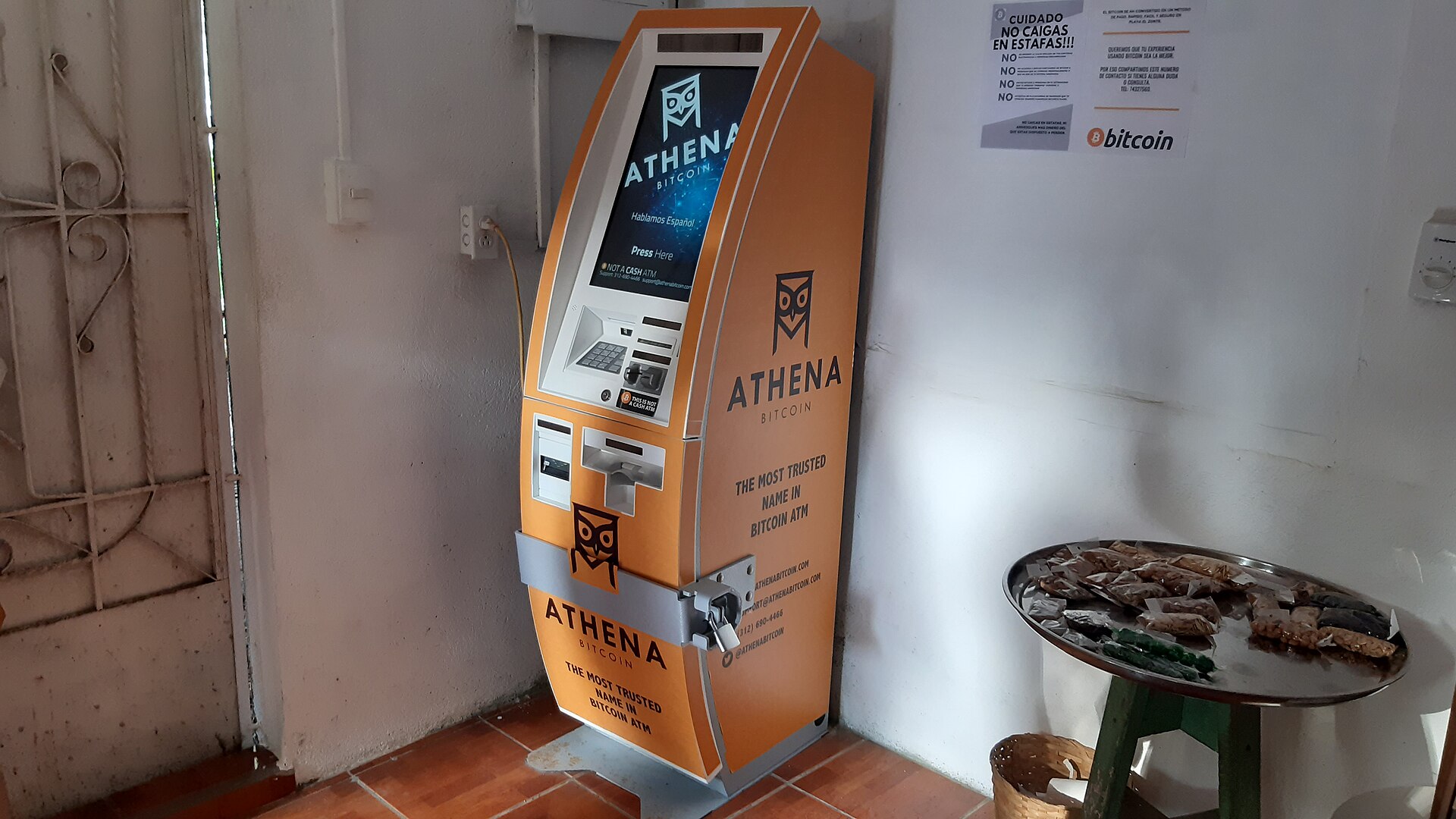
Cambridge location estimates came from four pools representing about 37% of hash power; they are a sample, not a census. Difficulty values are reproduced from the public headers at the first block of each adjustment period. Cambridge data · May starting block · July trough · October blockEl Zonte / June 2021. A bitcoin ATM before the national law took effect. Physical access points made the digital policy visible—and introduced operators, fees and custody choices.
Photograph: Karlalhdz · CC BY-SA 4.0 · Wikimedia Commons
A country makes bitcoin legal tender alongside the U.S. dollar.
El Salvador’s Bitcoin Law took effect ninety days after publication. It required economic agents, with stated exceptions,
to accept bitcoin when offered and created a government-backed conversion mechanism. The state promoted a custodial wallet
called Chivo and funded infrastructure intended to reduce exchange-rate friction for users.
The experiment blended distinct ideas: an open network, a legal-tender mandate, public financing and a state-operated
service. Adoption claims were contested, technical problems accompanied the rollout and exposure to price volatility
became a public-policy issue. Calling the law “Bitcoin adoption” without separating voluntary network use from government
implementation obscures much of what was being tested.
REC 21ConsensusBIP 341 / HEIGHT 709,632
Taproot activation
Schnorr signatures and selective revelation expand the scripting toolkit.
Taproot introduced a new output type built around Schnorr signatures. A cooperative spend can use a compact key path;
alternative conditions can be arranged in a tree and reveal only the branch actually used. Tapscript also created a more
adaptable foundation for future script changes.
The efficiency and privacy gains are conditional, not automatic anonymity. They depend on how wallets construct and spend
outputs, and blockchain observers can still see public transaction data. Taproot’s relatively orderly activation also
reflected lessons from the contentious SegWit era.
REC 22CustodyFEDERAL CASE RECORDS / 2022–2023
FTX
Another intermediary failure repeats an old lesson at a larger institutional scale.
Cryptocurrency exchange FTX entered bankruptcy after a liquidity crisis exposed severe problems in the handling of
customer assets. U.S. prosecutors later alleged fraud, money laundering and campaign-finance offences; founder Sam
Bankman-Fried was convicted on fraud and conspiracy counts in 2023.
FTX involved many assets and businesses beyond Bitcoin, but its collapse again separated an exchange ledger from a public
blockchain. Customers could see account balances without controlling the underlying keys. As with Mt. Gox, continued block
production did not erase the economic harm caused by failed custody and governance.
A court ruling forces reconsideration; exchange listings follow.
The U.S. Securities and Exchange Commission had repeatedly rejected proposals for exchange-traded products holding spot
bitcoin while permitting products based on bitcoin futures. In August 2023, the D.C. Circuit ruled that the agency had not
adequately explained its different treatment of Grayscale’s proposal and vacated the denial.
On 10 January 2024, the SEC approved exchange rule changes allowing a group of spot bitcoin exchange-traded product shares
to list and trade. The decision broadened brokerage access and brought large regulated custodians into the market. It did
not approve or endorse Bitcoin itself.
The ownership model is also different from self-custody. An ETP investor owns shares representing an economic interest in
a vehicle; the fund and its service providers arrange custody of the underlying bitcoin. The wrapper improves familiarity
and access while concentrating coins and operational responsibility in institutions.
REC 24IssuanceHEIGHT 840,000 / MAX SUBSIDY 6.25 → 3.125 BTC
Fourth halving
The subsidy falls to 3.125 BTC per block.
Bitcoin entered its fifth subsidy era at 00:09:27 UTC according to the block header timestamp. At the target pace of 144
blocks per day, expected new issuance fell to about 450 BTC per day—one sixteenth of the launch-era rate.
More than 93 percent of the conventional 21 million cap had been allocated through maximum subsidies by this boundary.
Unspendable outputs, lost keys and miners claiming less than the full reward mean maximum allocation is not the same as
liquid or spendable supply.
As prior actions under an International Monetary Fund program, legislative reforms made private-sector bitcoin acceptance
voluntary, returned tax payments to U.S. dollars and constrained public-sector participation. The IMF described the
amendments as removing essential features of bitcoin’s legal-tender status.
The reversal matters because national policy is not consensus code. A law can be enacted, implemented unevenly and later
amended while the underlying network continues unchanged. “Bitcoin became legal tender” is therefore a dated historical
statement, not a complete description of El Salvador’s current regime.
REC 26Law & policyExecutive order / 6 Mar 2025
Strategic Bitcoin Reserve
An executive order establishes a federal holding policy for forfeited bitcoin.
A U.S. executive order created a Strategic Bitcoin Reserve initially capitalized with bitcoin already owned by the federal
government through final forfeiture. It directed that deposited reserve BTC not be sold and called for an accounting of
federal digital-asset holdings.
The order authorized the Treasury and Commerce departments to develop budget-neutral acquisition strategies, subject to
existing law. It did not appropriate money for an open-market buying program. The distinction is significant: the policy
concerned custody, disposition and possible future acquisition methods, not a change to Bitcoin or an automatic purchase
mandate.
What changed
Bitcoin became easier to encounter through law and conventional finance, even as those gateways concentrated custody and policy risk outside the protocol.
The unfinished history
What remains unresolved?
Bitcoin’s history is not a straight line toward inevitability. Its most important questions remain active design, market and political problems.
01Security budgetWill future demand for block space generate enough fees as the subsidy declines?
02Scale and verificationHow much activity should settle on the base layer, and what trust trade-offs will users accept elsewhere?
03Custody concentrationWill institutional access place growing shares of bitcoin behind a small number of custodians?
04Privacy and policyCan open transaction verification coexist with practical financial privacy and changing national rules?
Method & sources
How this record was assembled.
01
Primary records come first. Mailing-list posts, source code, block records, court opinions, laws and official announcements are linked beside the relevant passage.
02
Dates have different meanings. Block dates are UTC header timestamps, not independent proof of the exact physical mining moment. Legal and market events use the dates in their official records.
03
Protocol, business and policy are kept separate. A company failure is not described as a consensus failure; a legal designation is not described as a protocol upgrade.
04
Interpretation is labelled by context. Claims about motives, significance and future effects are distinguished from what the primary record itself establishes.
Published and maintained by the Degrees of Satoshi editorial project · Last substantively reviewed 8 August 2026 · Educational history, not investment advice.
Continue exploring
Every address enters this history somewhere.
Degrees of Satoshi traces an address through Bitcoin’s transaction graph toward the network’s earliest mined coins.