Dossier 01 Source-led history · Edition 1.0
The Origins of Bitcoin: From Cryptographic Prehistory to Block 0
Bitcoin was not one sudden cryptographic invention. Its novelty lay in arranging signatures, linked timestamps, proof-of-work, network validation, and an issuance incentive into a system that strangers could operate without a central ledger keeper.
In this dossier
At a glance
Verified record
| Date | Record | Verified detail | Source |
|---|---|---|---|
| 1976 | New Directions in Cryptography | Diffie and Hellman described public-key cryptography and digital signatures as a way to authenticate messages without a previously shared secret. | [1] New Directions in Cryptography |
| 1991 | Linked timestamping | Haber and Stornetta described a hash-linked sequence of time-stamped records designed to make retroactive alteration evident. | [2] How to Time-Stamp a Digital Document |
| 2002 paper; earlier proposal | Hashcash | Adam Back specified a reusable verification procedure for computational proofs attached to messages; the work was intended principally as an anti-abuse mechanism, not a currency. | [3] Hashcash paper |
| 1998 | b-money | Wei Dai proposed pseudonymous participants maintaining balances and using computational work in a monetary protocol, while explicitly leaving coordination questions open. | [4] b-money proposal |
| 31 October 2008 | White-paper announcement | Satoshi posted a link to Bitcoin: A Peer-to-Peer Electronic Cash System to the Cryptography Mailing List. | [5] White-paper announcement |
| 3 January 2009 | Genesis block | The hard-coded mainnet genesis block has time 1231006505, bits 0x1d00ffff, nonce 2083236893, and the Times headline in its coinbase input. | [7] Genesis-block implementation |
| 8 January 2009 | Bitcoin v0.1 announcement | Satoshi announced the first public software release as a peer-to-peer system intended to prevent double-spending without a central authority. | [8] Bitcoin v0.1 release announcement |
| 12 January 2009 | Block 170 | Transaction f4184f…9e16 spent a 50 BTC output and created a 10 BTC recipient output plus a 40 BTC change output. | [9] Transaction f4184f…9e16 |
The origin story has different kinds of evidence
A technical ancestry is not the same thing as a prior implementation. Public-key signatures, linked timestamps, and computational proofs all predated Bitcoin, but none of those records describes the complete operational system launched in 2009. The useful historical question is therefore not whether one older document was ‘Bitcoin before Bitcoin.’ It is which problem each component addressed, which problems remained, and how the released system changed their relationship.
The record also supports different levels of certainty. Papers and source code establish what their authors wrote or implemented. Blocks establish that particular serialized data entered the accepted chain. Mailing-list messages establish what participants said at the time. None of those sources can independently prove every private motive attributed to Satoshi, and later recollections should not silently replace contemporary records.
Signatures and timestamps supplied verifiable authority and order
Diffie and Hellman’s 1976 paper made it possible to imagine authentication without a prearranged shared secret. In Bitcoin, an owner authorizes a spend with a digital signature, while validating software checks that authority. A signature does not by itself prevent the same output from being signed into two conflicting transactions; the network still needs a common way to determine which history to accept.
Haber and Stornetta addressed a related record-integrity problem by linking time-stamped documents with hashes. Altering an earlier record would disturb later links. Bitcoin likewise commits each block header to its predecessor, but adds an open competition for appending blocks and a rule for comparing competing histories by accumulated proof-of-work. The resemblance is real, while the consensus and incentive mechanisms are additional steps.
Proof-of-work and digital-money proposals moved closer to an open ledger
Hashcash made a computational proof cheap to verify and costly to produce. Its stated use was rate-limiting abuse such as unsolicited email. Bitcoin repurposed that asymmetry: miners vary block-header data until a hash falls below a network target, and nodes can verify the result quickly. Proof-of-work does not validate signatures or monetary limits; it helps order blocks that have already passed a node’s rules.
Wei Dai’s b-money described pseudonymous participants maintaining accounts and using computational work in a monetary scheme. It is an explicit white-paper reference and an important conceptual antecedent. Yet its first protocol depended on a collective accounting process that was not presented as a deployed, permissionless network. Bitcoin’s contribution was not simply citing the idea, but specifying and releasing a mechanism intended to converge on one public transaction history.
The white paper entered a skeptical technical conversation
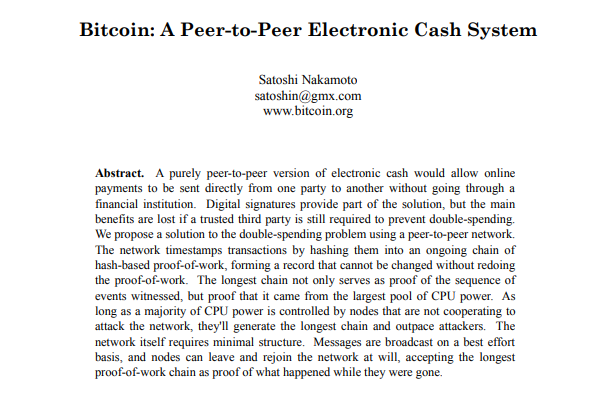
On 31 October 2008, Satoshi announced a nine-page paper whose opening claim was narrowly framed: online payments could be sent directly without passing through a financial institution. The paper combined transactions, a peer-to-peer timestamp server, proof-of-work, network rules, incentives, and simplified verification. It described the longest chain as evidence of the sequence of events and of the largest pool of CPU power invested in it.
Mailing-list responses immediately questioned botnets, scaling, incentives, and whether participants could converge on a shared view. Those objections matter because they show the proposal was not received as self-evidently complete. Satoshi’s replies supplied details absent from the paper and repeatedly pointed toward the forthcoming code. The historical unit is therefore paper, debate, and implementation together—not the PDF in isolation.
Block 0 is both executable configuration and historical artifact
The mainnet genesis block is constructed in source code with fixed header values and a coinbase input containing ‘The Times 03/Jan/2009 Chancellor on brink of second bailout for banks.’ The newspaper reference establishes that the block could not have been created before that edition appeared. It also anchors the launch in the banking-crisis period, but the text alone does not settle whether its purpose was proof of date, political commentary, or both.
The block’s nominal subsidy is 50 BTC, but the output is not spendable through ordinary validation because the genesis transaction was never inserted into the initial unspent-output database. More consequentially, block 0 supplied the parent reference for the public chain. Every later accepted mainnet block descends from a starting record whose exact construction remains inspectable in current Bitcoin Core.
A second participant turned a private implementation into a network
The v0.1 release joined wallet, node, and CPU-mining functions in one program. Early peers did more than download a demonstration: they received and checked blocks, relayed transactions, and could extend the chain. This was the transition the paper could not perform by itself. Shared validation among independently controlled machines made the record something other than a database operated solely by its author.
At block 170, transaction f4184f…9e16 spent a previously mined 50 BTC output and created outputs of 10 BTC and 40 BTC. Hal Finney later identified himself as the recipient of the 10 BTC, making this the earliest widely recognized person-to-person transfer. The structure is historically useful because it makes Bitcoin’s accounting model visible: outputs are consumed in full and replaced by newly specified outputs. Neither the transaction nor Finney’s account is evidence that Bitcoin had already become broadly used money.
A component-provenance map
The table distinguishes a precursor’s contribution from the additional role it plays inside Bitcoin.
| Component | Earlier record | Role in Bitcoin | What the earlier record did not itself establish |
|---|---|---|---|
| Digital signatures | Diffie–Hellman, 1976 | Authorize spending conditions checked by nodes | A shared ordering of conflicting spends |
| Hash-linked timestamps | Haber–Stornetta, 1991 | Commit each block to its predecessor | Open participation and chain selection by accumulated work |
| Computational proof | Hashcash | Make block production costly and verification inexpensive | A ledger, monetary issuance, or transaction validation |
| Distributed digital money | b-money, 1998 | Conceptual precedent for pseudonymous network money | A deployed longest-proof-of-work-chain implementation |
| Bitcoin system | Nakamoto paper and code, 2008–2009 | Combines validation, ordering, incentives, and issuance | Broad adoption or proof of the creator’s private motives |
Evidence discipline
What the record establishes
The white paper cites Hashcash and b-money and describes a hash-based proof-of-work timestamp server.
[6] Bitcoin white paperThe mainnet genesis parameters and embedded headline remain specified in Bitcoin Core source.
[7] Genesis-block implementationTransaction f4184f…9e16 is confirmed in block 170 and creates 10 BTC and 40 BTC outputs.
[9] Transaction f4184f…9e16Bitcoin’s principal novelty is best understood as system-level synthesis rather than a previously unknown cryptographic primitive.
[6] Bitcoin white paper · [7] Genesis-block implementation · [1] New Directions in Cryptography · [2] How to Time-Stamp a Digital Document · [3] Hashcash paper · [4] b-money proposalLimits
What this record does not establish
- A citation from Bitcoin does not mean an antecedent’s author endorsed Bitcoin or described the same complete system.
- The genesis headline proves a not-before date and deliberate inclusion; any fuller statement about Satoshi’s politics is interpretation.
- The phrase ‘first Bitcoin transaction’ should be qualified: block 170 is the first widely recognized person-to-person transfer, while genesis and mining transactions predate it.
Direct answers
Frequently asked questions
What did Bitcoin invent?
Bitcoin’s historical novelty is best described as a working system-level synthesis. It combined existing ideas in signatures, hash-linked timestamping, proof of work, peer-to-peer communication, incentives, and ledger ordering into a released network without a central account keeper.
Who received the first recognized person-to-person Bitcoin transaction?
Transaction f4184f…9e16 is confirmed in block 170 and created 10 BTC and 40 BTC outputs. The blockchain establishes that structure; Hal Finney’s later first-person account identifies him as the recipient of the 10 BTC test transfer.
Does the genesis-block newspaper headline prove Satoshi’s politics?
No. The source code proves that the headline was deliberately embedded and supplies a not-before date for block 0. A broader claim about Satoshi’s political beliefs remains interpretation unless supported by separate evidence.
Source register
Sources, datasets and technical references
Retrieved and reviewed 9 August 2026- New Directions in CryptographyWhitfield Diffie and Martin E. Hellman · 1976-11 · DOI 10.1109/TIT.1976.1055638IEEE Transactions on Information Theory / Stanford mirror · primary paper
Public-key cryptography and digital-signature concepts were published in 1976.
Open source - How to Time-Stamp a Digital DocumentStuart Haber and W. Scott Stornetta · 1991-01 · DOI 10.1007/BF00196791Journal of Cryptology · primary paper
Hash-linked timestamping for tamper-evident records predates Bitcoin.
Open source - Hashcash paperAdam BackHashcash.org · primary paper
Hashcash specified a publicly verifiable computational proof mechanism.
Open source - b-money proposalWei Dai / Satoshi Nakamoto Institute archive · primary proposal mirror
The archived 1998 text proposes pseudonymous network money and collective account maintenance.
Open source - White-paper announcementCryptography Mailing List · primary correspondence
The paper was publicly announced on 31 October 2008 with its stated peer-to-peer cash objective.
Open source - Bitcoin white paperSatoshi NakamotoBitcoin.org · primary specification
The published design, references, network procedure, incentives, and simplified-verification argument.
Open source - Genesis-block implementationBitcoin Core · primary source code
The original code fixes the headline, time, bits, nonce, and genesis-block hash.
Open source - Bitcoin v0.1 release announcementCryptography Mailing List archive · primary correspondence mirror
Satoshi announced the first public release and described its peer-to-peer purpose.
Open source - Transaction f4184f…9e16Blockstream block explorer · primary blockchain record
The transaction’s inputs, outputs, identifier, and confirmation in block 170; the chain record does not identify the recipient.
Open source - Hal Finney’s first-person accountHal Finney · 2013-03-19BitcoinTalk · primary participant account
Finney identified himself as the recipient of Bitcoin’s first person-to-person transaction and described Satoshi sending him ten coins as a test.
Open source
Cite this dossier
A dated, versioned reference
Degrees of Satoshi editorial project. “The Origins of Bitcoin: From Cryptographic Prehistory to Block 0.” Degrees of Satoshi, version 1.0. Published 8 August 2026; last reviewed 9 August 2026. https://degreesofsatoshi.com/history/origins-of-bitcoin/
Contemporary primary records are preferred. Protocol behavior, business failures and government policy are treated as separate evidence categories. Interpretive claims are explicitly bounded; corrections should cite a source at least as strong as the record being revised.
Read the research standards